

If you sell on eBay, here’s the thing: your price tag doesn’t tell you what you actually earn. Fees, shipping, and cost of goods chip away at your profit long before the payout hits your account. So let’s break down every major eBay fee and calculate your real margin step by step.
What eBay Seller Fees Actually Include
Most sellers only think about the final value fee, but that’s just one slice of the total picture. Your margin depends on understanding the full stack of expenses.
1. Final Value Fees (FVF)
This is eBay’s main fee.
eBay charges a percentage of the total sale amount, including:
– item price
– shipping charged to the buyer
– any handling fees
– sales tax (in some categories)
Typical Range: 8% to 15% depending on category.
Example:
If you sell a jacket for $50 + $6 shipping:
Total sale amount = $56
If your fee rate is 13% → eBay fee = $7.28
2. Flat $0.30 Per-Order Fee
Every order includes a $0.30 processing fee.
Simple, but it adds up fast on low-ticket items.
3. Promoted Listings (Optional but Common)
If you run ads, the fee is based on the final sale amount and your ad rate.
Ad rate can be anywhere from 2% to 20%.
If your ad rate is 5% on a $56 sale → Ad fee = $2.80
4. Store Subscription Fees
If you have an eBay Store, you’re paying for it monthly:
– Starter: $4.95–$7.95
– Basic: $27.95–$28.00
– Premium: $74.95–$79.95
– Anchor: $299–$349
– Enterprise: $2,999.95
This affects your long-term margin, not per-item margin.
5. Shipping Costs
Even if the buyer pays shipping, you still need to include:
– actual carrier fees
– packaging
– label fees
– handling time costs
Shipping is where many sellers lose their margin because they underestimate costs.
6. Cost of Goods Sold (COGS)
Your product cost directly determines whether your eBay sale is profitable.
The Real Formula for Your True eBay Profit Margin
Let’s simplify it. Your true profit is:
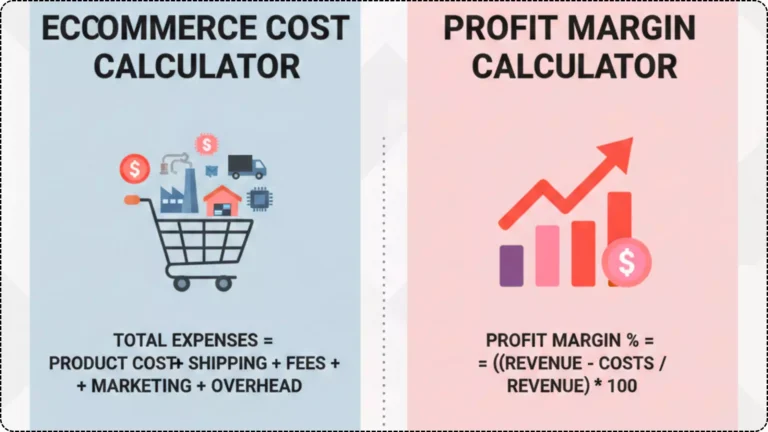
Profit = Sale Price – eBay Fees – Ad Fees – Shipping – COGS
Then calculate margin:
Profit Margin = (Profit / Sale Price) × 100
Real-World Example: The Jacket Scenario
Item sold for: $50
Shipping charged to buyer: $6
Total sale amount: $56
Costs:
– Cost of product (COGS): $20
– Actual shipping cost: $7
– eBay fee (13%): $7.28
– Order fee: $0.30
– Ad fee (5%): $2.80
Total fees and costs:
20 + 7 + 7.28 + 0.30 + 2.80 = $37.38
Profit:
56 – 37.38 = $18.62
Profit Margin:
(18.62 / 56) × 100 = 33.25%
Most sellers think they’re making a 60% margin on a $50 item.
In reality, this example shows how quickly fees drag it down.
Why Margins Shrink on eBay
Here’s what usually kills profit:
- Underestimating eBay FVF and ads
- Charging too little for shipping
- Selling low-priced items that get hit by the $0.30 per-order fee
- Not tracking the effect of promoted listings
- Competing solely on price instead of product value
How to Protect Your Margin on eBay
Let’s make this simple. You can keep more money by doing a few smart things:
1. Build fees into your pricing
Calculate your total cost first, then set your selling price—not the other way around.
2. Use promoted listings strategically
High-ad-rate categories = lower margin.
Only promote listings that actually need visibility.
3. Watch your shipping weight
One ounce can move you into a higher shipping tier.
4. Use an automated profit margin calculator
This eliminates guesswork and shows your true profit before you list.
Category Fee Examples
Different eBay categories have different fees. Here’s a quick snapshot:
| Category | Final Value Fee Range |
|---|---|
| Clothing & Accessories | 12%–15% |
| Electronics | 6%–12% |
| Home & Garden | 10%–13% |
| Automotive Parts | 7%–10% |
| Collectibles | 12%–15% |
Always check category fees before entering a niche.
Common Questions About eBay Seller Fees
Are eBay fees taken automatically?
Yes. eBay deducts them from your payout.
Do I pay fees if the buyer returns an item?
In most cases, eBay refunds a portion of the fee, not the full amount.
Are promoted listing fees charged if the buyer finds my item organically?
No. You’re only charged when the promoted link leads to the sale.
Does eBay charge fees on shipping?
Yes. They calculate percentage fees on item price + shipping.
Can I raise my price to cover the fees?
Absolutely. That’s standard practice.
Are fees the same for auctions?
They’re similar, but high-value auction items may have special caps.
Do store subscribers get lower fees?
Yes. Stores pay reduced final value fees in most categories.
What is the average profit margin on eBay?
Most sellers land in the 10–30% margin range after all expenses.
Final Thoughts
What matters isn’t your sale price—it’s your true margin after everything that hits your bottom line. Once you see how eBay fees stack up, your pricing strategy changes fast.
If you want to stop guessing, plug your numbers into a profit margin calculator so you can list with confidence and protect every dollar you earn.